The project has three main objectives: to help newly enrolled students orient themselves both physically (new spaces and their use) and academically (degree structure, regulations, tools, and common challenges); to foster the creation of new social relationships by working in small groups on non-academic content; and finally, to provide them with tools to develop effective and healthy study habits.
The key element of the project is to make the most of the experience and generational proximity of more advanced FIB students in supporting newly enrolled students.
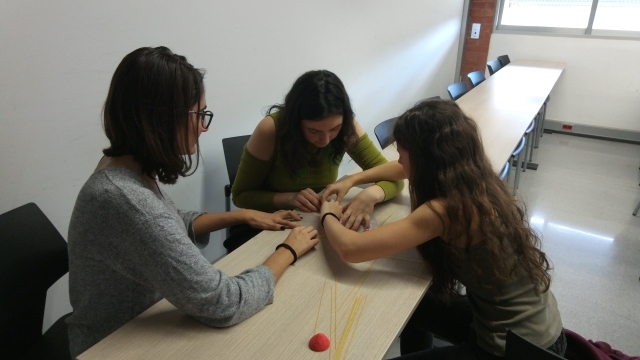
Senior students are responsible for welcoming and supporting newly enrolled students through what is known as peer mentoring.
The project, which originated as an initiative of the FIB management team, has been supported since its inception by the FIB Student Delegation (DEFIB). During its first two editions, the programme was offered to students of the GEI degree, while in the third edition it was extended to include students from the GCED degree.
Before the summer break, volunteer mentors receive free training in coaching tools, lasting approximately 10 hours. Mentoring sessions begin during the first week of classes. Each mentor is responsible for a group of 15 to 18 newly enrolled students, and, as with other courses, all communication between mentors and their groups is conducted through the Racó platform.
Each mentoring group in the GEI programme (about 28 groups in total) participates in seven one-hour sessions. The first three sessions are scheduled during the first three weeks of the semester, and the remaining sessions are held roughly every two weeks. All groups are expected to complete their seven sessions by the end of November. Undergraduate mentors who successfully complete the programme earn up to 2 ECTS credits for university activities, as well as official certification from ICE for the Coaching course.

Opinions
Mentees’ Testimonials
Mentor Testimonials
Press
The newspaper El Punt Avui published a couple of articles explaining the pilot programme (El Punt avui, Raül Garcia i Aranzueque, 19 June, 2017). To gather information, they came to FIB and interviewed five mentors and five mentees.
The magazine L’Oasi, published by FIB students, dedicated a full page in issue 55 to the Peer Mentoring programme to highlight its usefulness.
Past editions
This year, the Peer Mentoring Programme returned in full force to continue supporting newly enrolled students in their first steps at FIB.
This edition marks the ninth year of the programme for GEI students, the seventh for GCED students, and the fourth for GIA students.
Participation and coordination:
A total of 41 mentors participated, distributed as follows:
- 1 per each of the 26 GEI groups
- 9 distributed among the 3 GCED subgroups
- 6 for the 3 GIA subgroups
All supported by a GEI student serving as coordinator: Carla Cordero.
Training and follow-up:
- Once a year, in June and September, two in-person editions of the training course Techniques to Connect and Support in Mentoring are held.
- Three follow-up meetings are conducted, attended also by the Vice Dean in charge of initial-phase studies and responsible for the programme.
Results and evaluations:
- 100% of the mentors who responded to the survey would recommend the programme to both new students and future mentors.
- Motivations for being a mentor:
- 50% consider it a useful activity for students.
- 31.8% joined to experience being a mentee themselves.
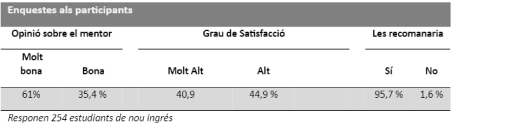
- 180 mentees responded to an evaluation survey, with the following results:

Finally, we would like to thank all the mentors of this edition, who not only worked hard to make the transition to university life easier for new students but also provided an opportunity to create bonds, share knowledge, and feel part of a great community!
This is the eighth edition of the Peer Mentoring Programme for GEI students, the sixth for GCED students, and the third for GIA students.
- There are a total of 42 mentors in charge of 26 GEI subgroups (16 in the morning shift and 10 in the afternoon shift), 3 GCED subgroups, and 3 GIA subgroups, coordinated by former GEI student Pablo Buxó. Of the 42 mentors, 26 are from GEI, 9 from GCED, and 7 from GIA.
- The seven mentoring sessions are held in-person between September and November.
- In June and September, two in-person editions of the training course Techniques to Connect and Support in Mentoring were held.
- Three general follow-up meetings were conducted with the mentors, also attended by the Vice Dean in charge of initial-phase studies, responsible for the programme.
- 73.81% of mentors responded to a survey (31 people). 100% of them would recommend the mentoring programme to new students, and 100% would recommend being a mentor at FIB. 54.84% became mentors because they consider it a useful activity for students, and 38.71% decided to become mentors after being mentored themselves when they first arrived at FIB.

This is the seventh edition of the Peer Mentoring Programme for GEI students, the fifth for GCED students, and the second for GIA students.
- There are a total of 33 mentors in charge of 23 GEI subgroups (14 in the morning shift and 9 in the afternoon shift), 4 GCED subgroups, and 2 GIA subgroups, coordinated by former GEI student Ismael Quiñones. Of the 33 mentors, 23 are from GEI, 8 from GCED, and 2 from GIA.
- The seven mentoring sessions are held in-person between September and November.
- In June and September, two in-person editions of the training course Techniques to Connect and Support in Mentoring were held.
- Three general follow-up meetings were conducted with the mentors, also attended by the Vice Dean in charge of initial-phase studies, responsible for the programme.
- 90.91% of mentors responded to a survey (30 people). 100% would recommend the mentoring programme to new students, and 100% would recommend being a mentor at FIB. 34.5% became mentors because they consider it a useful activity for students, and 41.4% decided to become mentors after being mentored themselves when they first arrived at FIB.
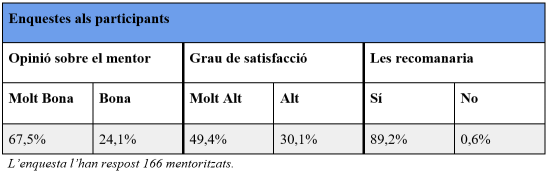
This is the sixth edition of the Peer Mentoring Programme for GEI students, the fourth for GCED students, and the first for GIA students.
- There are a total of 39 mentors in charge of 25 GEI subgroups (15 in the morning shift and 10 in the afternoon shift), 4 GCED subgroups, and 2 GIA subgroups, coordinated by GEI student Ismael Quiñones.
- The seven mentoring sessions are held in-person.
- In June and September, two in-person editions of the training course Techniques to Connect and Support in Mentoring were held, in the afternoon and morning respectively.
- Three general follow-up meetings were conducted with the mentors, also attended by the Vice Dean in charge of initial-phase studies, responsible for the programme.
- 97.44% of mentors responded to a survey (38 people). 100% would recommend the mentoring programme to new students, and 37 would recommend being a mentor at FIB. 47.4% became mentors because they consider it a useful activity for students, and 36.8% decided to become mentors after being mentored themselves when they first arrived at FIB.
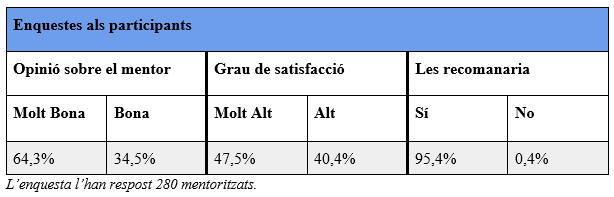
This is the fifth edition of the Peer Mentoring Programme for GEI students and the third for GCED students.
- There are a total of 28 mentors in charge of 20 GEI subgroups (12 in the morning shift and 8 in the afternoon shift) and 4 GCED subgroups, coordinated by GEI student Alberto Garrote.
- The seven mentoring sessions are held in-person; if students are in quarantine, a hybrid format is used.
- In September, two in-person editions of the training course Techniques to Connect and Support in Mentoring were held, in the morning and afternoon shifts.
- Three general follow-up meetings were conducted with the mentors, also attended by the Vice Dean of Students and the Vice Dean in charge of initial-phase studies, responsible for the programme.
- 100% of mentors responded to a survey (28 people). 100% would recommend the mentoring programme to new students, and 96.4% would recommend being a mentor at FIB. 60.7% became mentors because they consider it a useful activity for students.